
For restaurant owners
Your guests get a menu made for them.
You get to see what works.
A guest sits down and scans a small code on the table. They see your menu with proper photos, in their language, with the things they like near the top. They order when they are ready. You get to see which dishes sell, which ones people look at and skip, and who keeps coming back.
- Working by tomorrow
- Nothing to install
- Keep the till you have
- Cancel any month
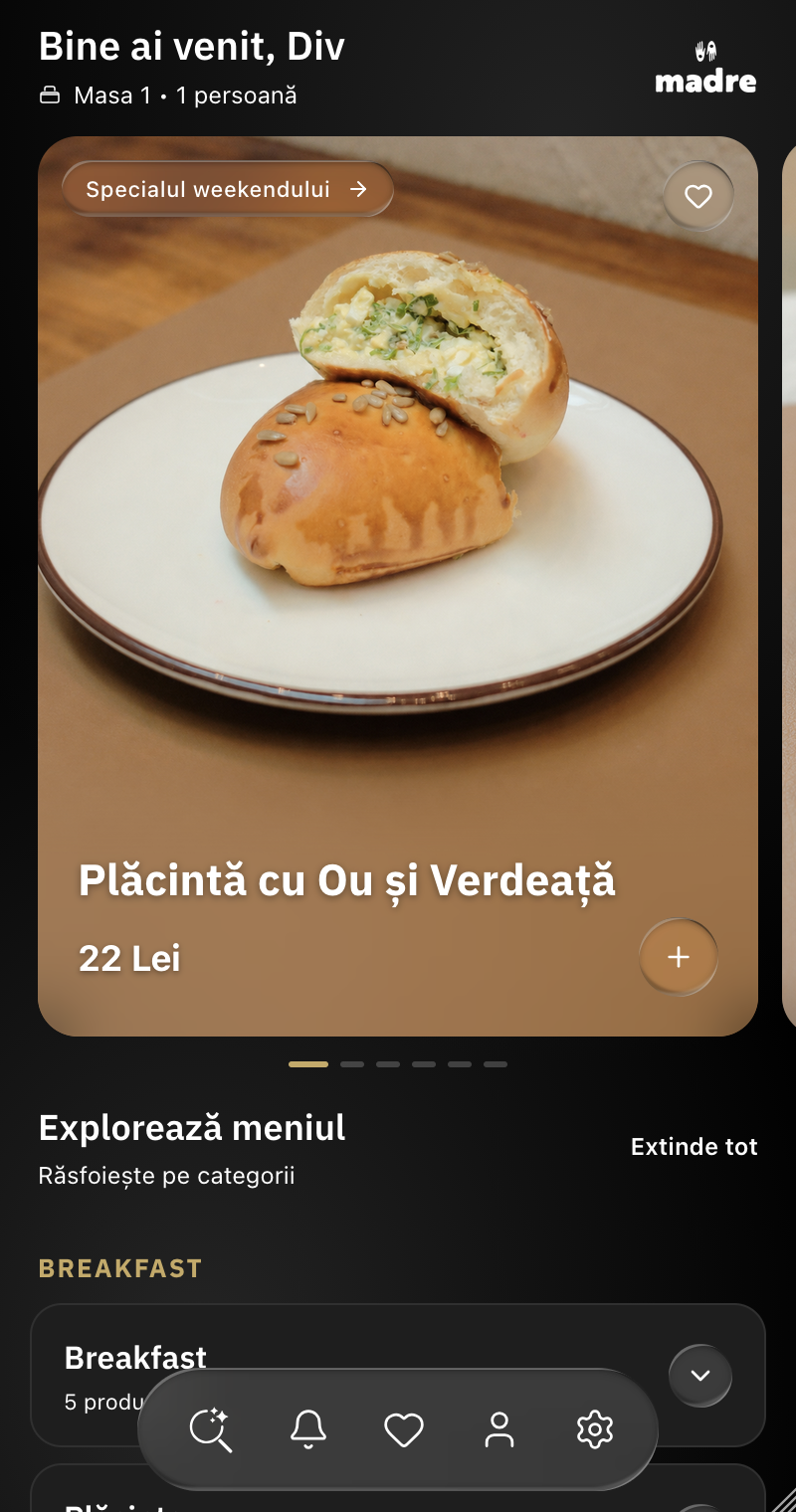
This is what your guest sees
Three things happen. That is all.
1
The guest scans
A small code on the table. No app to download. It opens straight away, like a web page.
2
They see your menu
With real photos and real prices, in their own language. If they have been in before, the things they liked are near the top.
3
You learn something
Which dishes sell, which ones people open and then skip, how long a table takes, and who your regulars are. Every night, without anyone writing anything down.
That is the product. Everything below is detail about each part and what it is worth to you. If you only read this far, you have the idea.
Six parts, all working now.
Everything in this section is live and running in real restaurants right now. Nothing here is a promise. What is still being built has its own section further down, clearly marked.
Part one · your guests
The menu on their phone
Your menu, but it knows something. A guest who said last time that they do not eat meat will not be shown the steak first. A guest who loved the gnocchi sees it near the top.
- Real photos of your food. We come and shoot every dish. It is included.
- Four languages. English, Romanian, French and Spanish, menu included.
- Allergies remembered. They say it once and it sticks to their profile.
- They order from the table. No waiting for someone to come over.
- A shared table. Four people, one order, everyone adding from their own phone at the same time.
- They split the bill themselves. Item by item, no maths at your till.
- They tip at the happiest moment. Right after a good meal, not on the way out.
What changes: tables turn faster because nobody waits to order or pay, and the average bill goes up because the right things are in front of the right people.
The menu, on a guest's phone
Part two · your guests
Something that answers their questions
Guests ask things. Is this spicy. Does it have nuts. What goes with this wine. What is good if I am not very hungry. They type it in their own words and get a straight answer, in a second or two.
- It only knows your menu. It searches your own dishes and will not invent one you do not serve.
- It answers as it thinks. Words appear straight away instead of a spinner.
- It suggests what goes together. A wine with the fish, a starter for the table.
- It reads out loud for anyone who would rather listen than read.
- Your staff stop being asked the same six questions forty times a night.
What changes: guests order with more confidence, so fewer plates come back and orders get bigger. Your floor staff spend their time serving instead of reciting the menu.
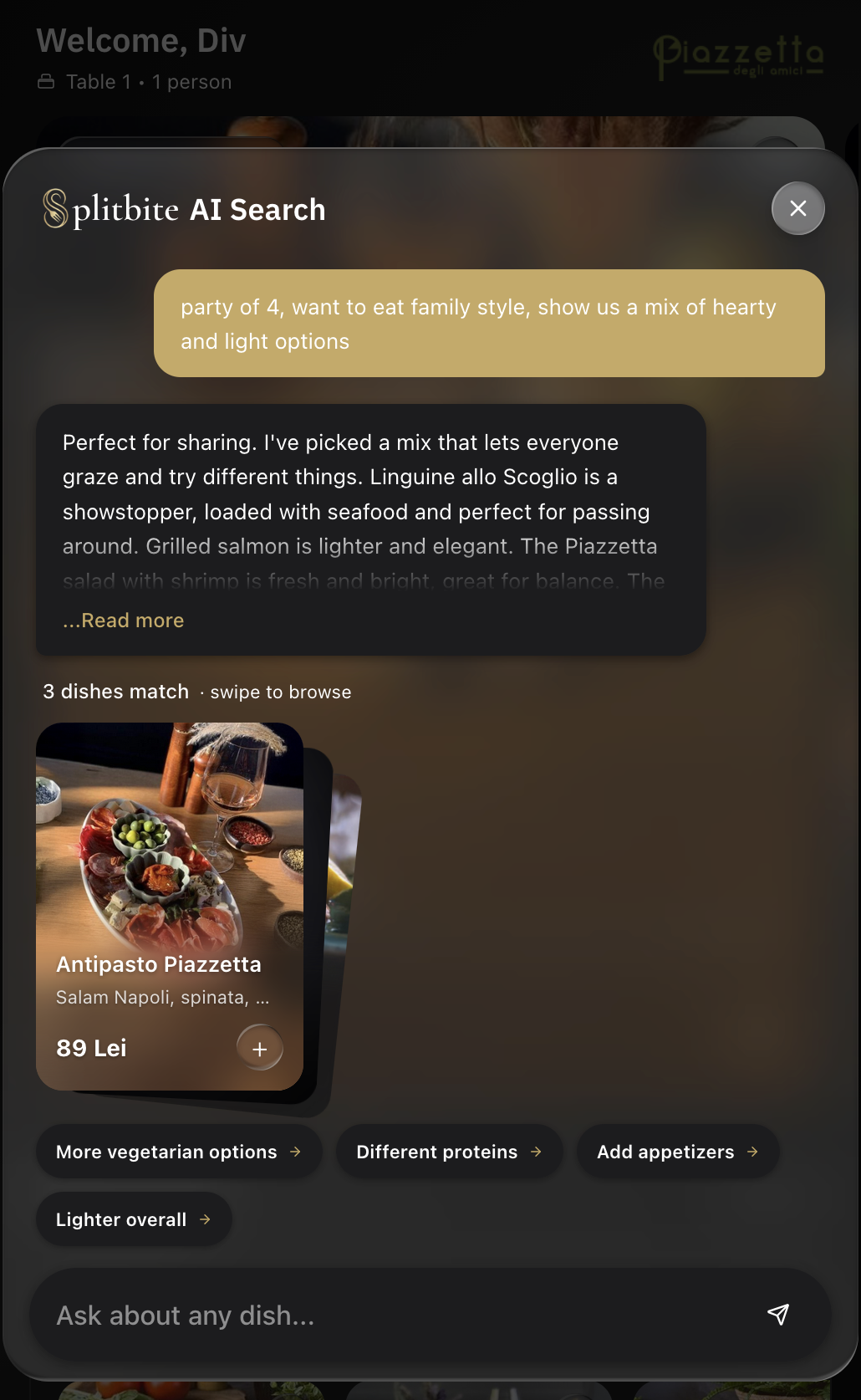
A guest asking a question
Part three · your floor staff
Your waiters stop crossing the room to check
Staff log in with a four-digit code on any phone. When a table needs something, the right waiter gets a notification straight away, with the table number and what it is about.
- It reaches their phone even with the app closed.
- They see the reason, not just a buzz. Water, the bill, a problem with a dish.
- You can see how fast they answered. Response times are recorded per person.
- It works in their language too. The same four languages as the guest side.
What changes: your staff walk less and see more. Nobody stands at a table taking an order the guest could place themselves, and nobody misses a table that needed something ten minutes ago.
Five things, one tap each
Part four · you
The screen you check with your coffee
Most owners run on a feeling about how last week went. This gives you the actual answer, in plain numbers. It is the part owners end up using most.
- Which dishes sell, and which only look good. Every dish shows views, adds to cart and orders, so you can see the ones people open and put back.
- How long guests spend looking at each dish before deciding. Down to the second.
- Where you lose people. Scan, looked at a dish, added to cart, ordered, paid. You see the drop at each step.
- Who your regulars are. Ranked by spend, with what each one orders and what they avoid.
- What guests asked for that you do not serve. Their actual words, most frequent first.
- Whether the suggestions pay. Average bill when a guest took a suggestion versus when they did not.
What changes: you stop guessing. You cut the three dishes nobody orders, you know which twenty guests are worth looking after, and you find out on Tuesday instead of at month end.
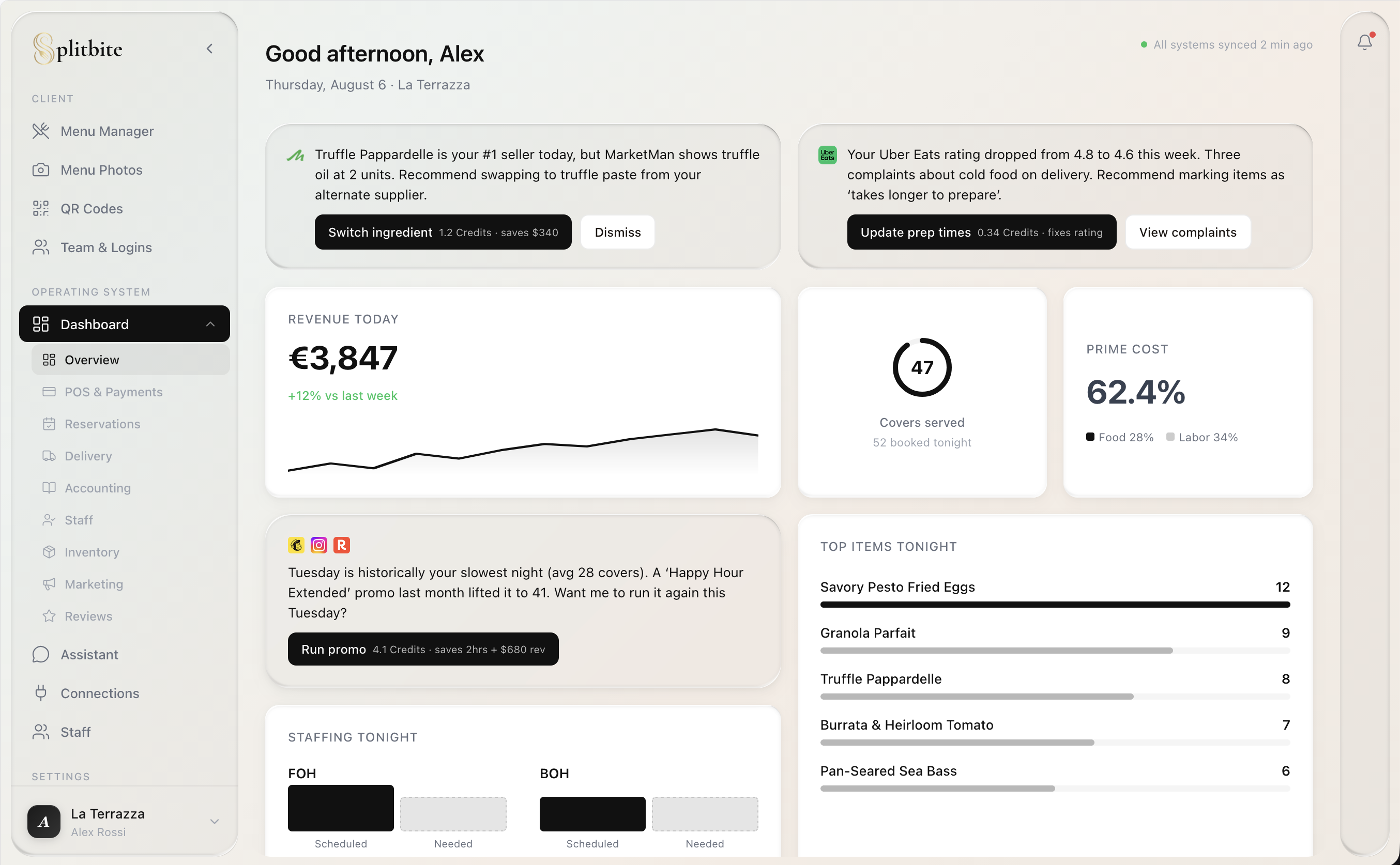
Your side of it, on a laptop
Part five · you
Changing the menu takes a minute, not a phone call
You are not waiting on us to change a price. You open the menu editor, change it, and it is live on every table straight away.
- Edit anything yourself. Prices, descriptions, categories, the order dishes appear in.
- Dishes that appear only when you serve them. Set the days and hours for a lunch menu and it hides itself the rest of the time.
- Drop in a folder of photos and it matches them to the right dishes by name.
- A photo editor built for food. Relight, straighten, crop, and export the exact sizes the delivery apps demand.
- It tells you when a photo will be rejected. Checked against real Uber Eats, DoorDash and Instagram requirements before you upload.
- Your QR codes, printed. Generate one per table, download them all as a zip.
What changes: a price rise takes a minute. Your delivery listings stop getting knocked back for bad images. And the lunch menu stops appearing at 9pm.
Checked from the actual pixels
Part six · getting you started
You give us your website. That is the whole job.
You do not type your menu into a spreadsheet. You give us a web address, or just your restaurant name and town, and an AI agent goes and builds the thing for you while you watch.
- It reads your website and pulls out every dish, price and description it can find.
- It fills the gaps. If your site is thin, it looks you up online for your hours, address and photos.
- It matches your photos to your dishes by looking at them, not by filename.
- It never makes up a price. If it cannot find one, it leaves it blank for you rather than guessing.
- Anything it wrote itself is marked so you know what to check.
- You watch it happen and approve before a single guest sees it.
What changes: the part that normally kills these projects, a week of typing your menu in, just does not happen.
You review, then it goes live
In build · early access
Stop checking eight apps. Ask one question.
Right now, finding out why last Tuesday was quiet means opening your till reports, your delivery dashboards, your rota tool and your reviews, one at a time. That is two to three hours a day of somebody's life.
We are building the thing that reads all of it and answers in a sentence. It is not finished, so we are not going to pretend it is. Here is exactly what it will do and where it stands.
Step one
Everything in one place
Your till, delivery apps, bookings, rota, accounts and reviews, pulled into a single screen so you stop hopping between tabs.
Step two
Ask it in plain words
"Why was Tuesday slow?" and it looks across all of them at once, then tells you the reason rather than handing you six charts.
Step three
It offers to fix it
Post the extra shift, reply to the review, change the prep time on the delivery app. You approve, it does it.
A real example of the answer.
This is the shape of it. One question, four systems checked, one cause, three things you can do about it without opening another app.
Cross-system answers like this need the connections finished first. That is the work in progress.
- Your rota
- Two staff called in sick.
- Your till
- Average ticket took six minutes longer than usual.
- Delivery
- Eight orders cancelled for being too slow.
- Reviews
- Two new one-star reviews, both mentioning the wait.
- The cause
- Short-staffed, so service slowed, so orders were cancelled and reviews suffered. All one problem, not four.
Illustrative of the intended behaviour, not a screenshot of a finished feature.
Honest status
- Working now
- Everything in the section above this one: the guest menu, the assistant, the waiter app, your analytics, the menu and photo tools, and automatic setup
- In build
- Connecting to your till, delivery apps, rota tool and accounts
- In build
- Asking questions across all of them in plain words
- In build
- Approving actions that it then carries out for you
- In build
- Watching your numbers and telling you when something needs attention
- In build
- Testing two versions of a dish, a price or a photo against each other
- Planned price
- €299 a month per restaurant, on top of your menu plan, including 500 AI actions
If any of these is the reason you would buy, tell us on the call and we will give you a straight date rather than a maybe. Early-access restaurants help shape it and pay less for it.
The bigger bill is the thing you notice first.
Same kitchen, same prices, same dishes. The only difference is the order they appear in and who the list was built for.
Average bill before
One menu. Everyone sees the same thing in the same order.
Average bill after
Built for each guest. Measured over 1,240 covers at one restaurant, against its own numbers from before.€6.50 more on 60 covers a night is about €142,000 a year
faster tables
Nobody waits to order and nobody waits to pay, so the queue at the end of the meal disappears.
less time on admin
Taking orders, splitting bills and answering the same questions stop eating paid hours.
more tips for your team
Guests are asked when they are happiest, and it goes to the person who served them. Your staff notice this in week one.
to be up and running
Menu imported, codes printed, staff briefed. About ten minutes of explaining to your floor.
These come from restaurants already using Splitbite, each measured against that restaurant's own numbers from before they started. Yours will be your own, and we will show them to you the same way.
The things other people charge you extra for.
One monthly price for everything in "what you get today". No setup fee, no per-table charge, no cheaper version with the useful parts removed.
Included
Photography
We come to you and shoot every dish, and again whenever the menu changes. A photographer charges for this on its own.
Included
Setting it up
The agent builds your menu from your website, and we check it with you before anything goes live.
Included
Four languages
Your menu in English, Romanian, French and Spanish, kept in step when you change a dish.
Included
A real person to call
Not a ticket system. The number is at the bottom of this page.
Included
Your QR codes
One per table, generated and ready to print.
Included
All your numbers
Every figure in part four, with no premium analytics tier.
Everything it learns stays with the business.
Most of what makes a restaurant work lives in the owner's head. Which regular drinks what. Which dishes carry the margin. What sells in February.
This writes it down as a side effect of running the place. So if you hand the restaurant to your son or daughter, or you sell it, the next person opens the same screen and knows what you knew. They do not spend two years learning it again.
It is not a project. It is a Tuesday.
The reason restaurant software usually fails is that it asks you to change everything first. This asks you to put some small codes on your tables.
And if you do not like it, leave.
You pay monthly. No contract holding you in, no penalty for stopping. Your data is yours and you can take it with you. We would rather you stayed because your bills went up.
Book the twenty minutesAnswered straight.
My guests hate QR menus. Is this that?
They hate them for a good reason. A code that opens a PDF of your menu is worse than paper and saves nobody anything except printing costs.
The test we hold ourselves to is whether the screen knows something paper cannot: who this person is, what they cannot eat, what they loved last time. And anyone who wants a printed menu should still be handed one. Keep some.
Do I have to get rid of my till?
No, and today you do not connect it at all. The guest menu, the waiter app and your analytics all work on their own, sitting alongside whatever you already use.
Reading from your till and writing back into it is part of what we are building next, in the section marked "what we are building next". Nobody has to change tills for this.
Which parts actually work today, and which are you still building?
Working today: the guest menu with photos and four languages, the assistant that answers guest questions, the shared table and bill splitting, the waiter app with notifications, all your analytics and the guest list, the menu and photo tools, and the automatic setup from your website.
Still being built: connecting to your till, delivery apps, rota tool and accounts; asking questions across all of them at once; approving actions it then carries out; watching your numbers and alerting you; and testing two versions of a dish against each other.
We split the page in two so you can see which is which. If a demo ever shows you something that is not in the working list, ask us to prove it.
I am not good with technology. Is this going to be my problem to run?
No. The setup is automatic and we check it with you. After that, what is left for you is looking at things in plain English and saying yes or no.
If you can read a delivery note and reply to an email, you can run this.
What does it cost?
It depends on how many tables you have, so we would rather give you a real number for your restaurant than a made-up one on a web page. It is one monthly fee with nothing on top, and on the call we will show you what it would cost and what it would earn, side by side.
If the second number is not comfortably bigger than the first, do not buy it. The part we are still building is planned at €299 a month per restaurant when it ships, and early-access restaurants pay less.
Will it send things to my guests without me knowing?
No. Nothing goes out in your name today, and when the campaign tools ship, anything going out will wait for you to look at it first. You see the words, the picture and who it is going to before it goes anywhere.
What happens to my guests' information?
Guests are asked before anything is remembered about them, and they can see it or delete it whenever they want. Your customer list stays yours and is never shown to another restaurant.
The full detail is in our privacy policy, written to be read rather than to hide things.
We are one small place, not a chain. Is this for us?
Yes, and small places get more out of it. A chain can already build a picture of a guest across its own restaurants. A single place has no way of knowing a first-time guest at all. That is exactly the gap this closes.
See it on your own menu.
Twenty minutes. Your real menu, your real numbers. You will see the guest side, your side, and what it would do in your first week. If it is not obviously worth it for your restaurant, we will tell you.
- Phone
- +40 726 025 944
- info@splitbite.ai
- We work in
- Romania, USA, Spain, France and Turkey
- Reply time
- One working day
- Terms
- Monthly, cancel any time, your data leaves with you